Why Pain Doesn't Always Mean Stop: Strength Training with Hypermobility and Chronic Pain
I have a really complicated relationship with pain.
A lot of people would say that having the knowledge I have about it is lucky. And in some ways it is. But I also think there's a specific kind of frustration that comes with knowing exactly what's happening in your body and still not being able to fix it. The map doesn't always get you where you're going.
I think about this a lot when it comes to people who don't work in fitness or rehab. If coaches and athletes who have spent their careers studying the human body still struggle with their own pain, what is it like for someone who doesn't have that background? Someone with a demanding job, limited time, and an internet full of conflicting opinions telling them what to do? Someone who is genuinely in pain and has no idea where to start?
That's the person I think about most.
Pain And Hypermobility Are Not Simple
When you have hypermobility, whether that's hEDS, generalized hypermobility, or chronic pain tied to connective tissue, pain is rarely straightforward. I spent years wanting to understand exactly why something was happening and exactly how to fix it. The hard lesson was that pain doesn't always work that way.
Compensations, posture, overuse, all of those things can contribute. But so can nervous system dysregulation, stress, and not recovering enough. And the thing that doesn't get talked about nearly enough is protective pain.
If you've had low back pain for a long time, your nervous system can still be generating pain signals long after the tissue has actually healed. It's not in your head. It's not weakness. Your body is being protective, trying to prevent it from happening again. That area becomes hypersensitive, and the work from there is about gradually reducing that sensitivity through consistent, appropriate loading. Not avoidance. Carefully managed movement.
And here's what makes this even more complicated: pain tends to create a really heightened awareness of sensation in your body. In the beginning, that's actually useful. You start paying attention, noticing patterns, trying to catch things before they get worse. That can work really well. But it becomes a double-edged sword. Hold onto that awareness for too long, and every sensation starts to feel like pain. Your nervous system stays on high alert. You get anxious. And you stop making progress because every time you feel tightness or sensitivity, you stop.
A really important part of working through pain is learning to trust that not every twinge or sensation is going to turn into something bigger. That trust builds slowly. But when it does, you start to feel more capable. And then you actually become more capable.
One of the hardest parts of all of this for me personally has been how misunderstood hypermobility is, even among people who should know better. I've worked with physios I trusted who made my injuries worse because they didn't understand how a hypermobile body actually responds to treatment. I've had so many clients come to me with the exact same story, sometimes from practitioners who marketed themselves as hypermobility specialists. Taking one short course doesn't give someone the depth of understanding needed to work with this population safely. That gap is real, and the consequences of it are real.
The Survival Instinct Problem
One of the biggest lessons I've had to learn is that pain doesn't always mean stop. That sounds simple. Living it is a completely different thing.
Every time I feel pain there's this internal conflict. My emotional brain wants it gone immediately. My logical brain knows that stopping isn't the answer. And my trainer brain knows we need to stay focused on the long-term goal, not the short-term discomfort. All three are running at the same time. It's a lot.
Training is, in a lot of ways, the opposite of what your survival instincts tell you to do. The instinct is to protect yourself, rest, avoid whatever is causing the pain. And sometimes that's right. But with hypermobility and chronic pain, avoiding everything that hurts tends to make things worse over time, not better.
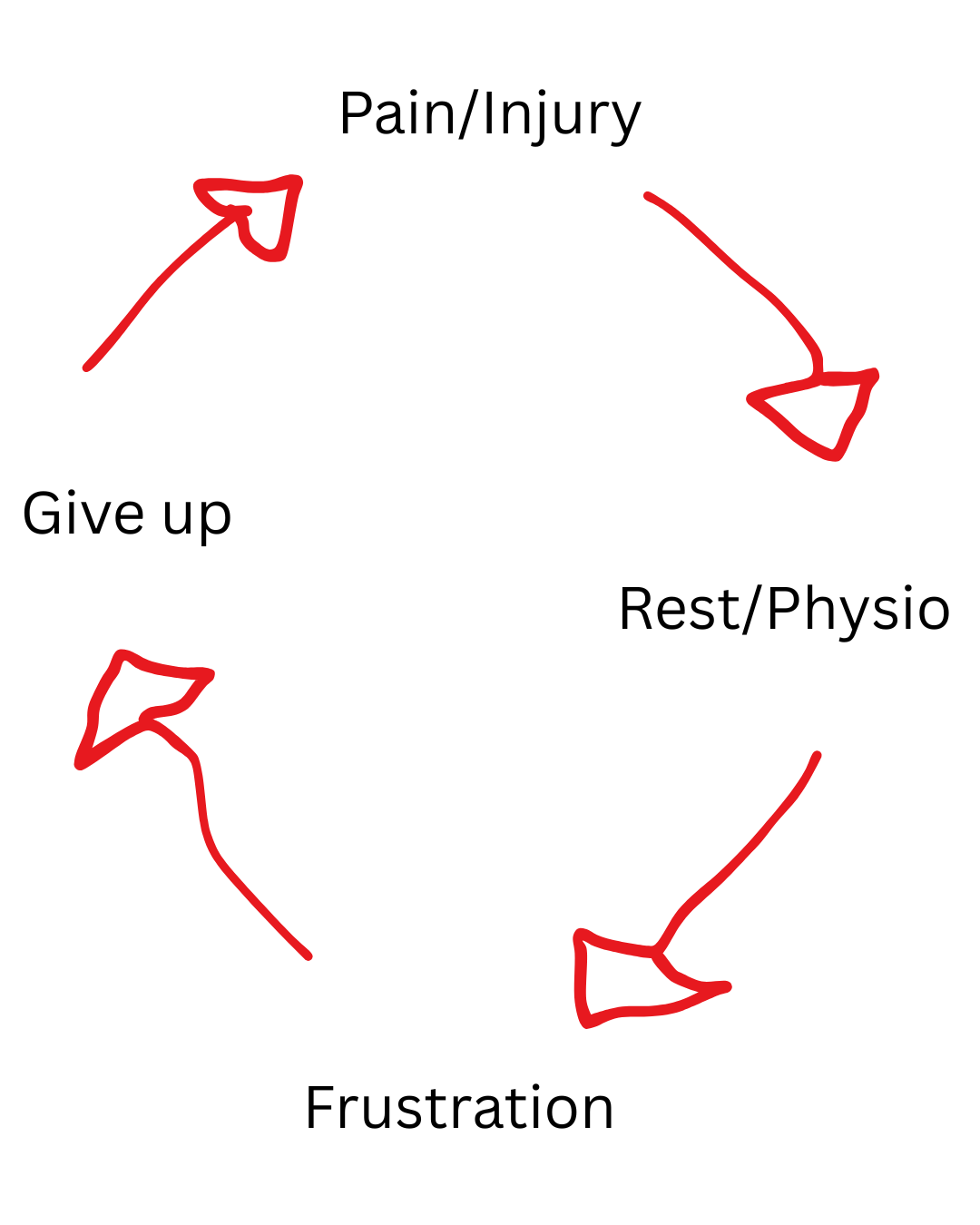
I've lived that version. Train hard, feel pain, stop everything, go to physio, feel a bit better, get bored of rehab, go back to training hard. Repeat. Most people with hypermobility know exactly what I'm talking about.
There's a quote I think about a lot: anxiety overestimates the threat and underestimates your ability to deal with it. That's exactly what pain does to you. Your brain starts spiraling. What if this gets worse? What if I can't do that race, that trip, that thing I've been so excited about? Should I rest completely? Go back to physio even though that went badly before? Just train anyway and ignore it?
Pain is emotional. And when the anxiety takes over, thinking clearly is genuinely hard. A lot of the time the answer is actually a lot simpler than the spiral makes it feel. Back off the volume for a week. Sleep more. Do some breathing work to bring your nervous system down. Remind yourself that a bit of knee pain is not the end of the world, even when it really feels like it is.
What Actually Changed Things
The real shift for me came when I stopped trying to be pain-free and started just trying to keep pain at around a 2 to 3 out of 10. Not pushing through it. Not ignoring it. Just being okay with some discomfort and continuing to move.
Pain went down over time. Strength went up. The cycle stopped.
Now when my pain flares I modify instead of stopping. My ego doesn't always love that. But the outcome with modification is better than it is with stopping completely, every single time.
Pain has taught me more patience than anything else. It's also taught me something that's a little uncomfortable to sit with: my gut feeling, the one telling me to stop and do whatever it takes to feel better right now, is usually not the right call. Pain makes it hard to trust yourself, especially when that instinct has let you down before.
The goal isn't to feel no fear around pain. It's to build enough of a history with your body that you can start to tell the difference between pain that's your nervous system being protective, and pain that's actually telling you to back off. That takes time. And it really helps to have someone who understands how a hypermobile body actually works.
If any of this sounds familiar, that's exactly who I work with.
I coach people with hypermobility, hEDS, and chronic pain through online strength training that's built around how their body actually works. Not a generic program. Not something designed for someone else's history.
If you want to work together, you can learn more about coaching here or get in touch directly.